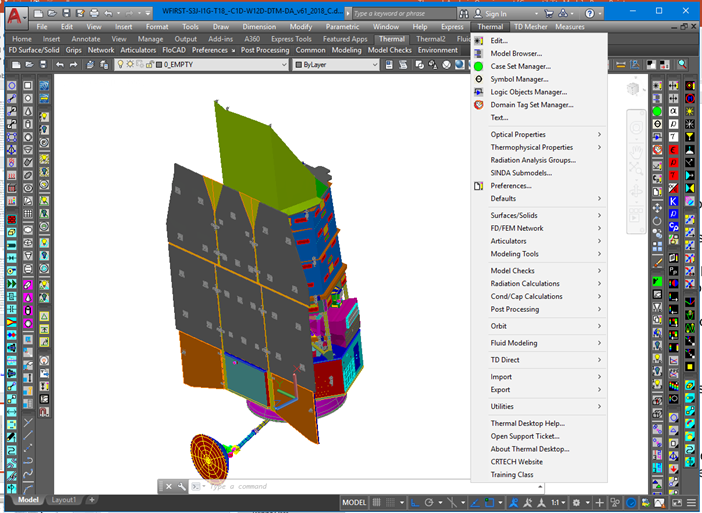
Thermal Desktop Overview
- Thermal Desktop is a complete CAD-based thermal engineering tool suite, widely used in aerospace, space launch, satellite and orbital applications
- It efficiently simulates complete systems
- Links to Ansys Flagships for models

Thermal Desktop 특징
- Support of CAD import and operations via AutoCAD
- Thermal Desktop is a plug-in to AutoCAD and uses the graphics engine to display thermal objects
- This includes Surfaces, Assemblies, Nodes, Conductors, Contactors, Heat Loads, Heaters, etc.
- Conduction formulation for centroid, edge-node, and finite elements
- Orbit definition and visualization
- Assemblies and Trackers for moving components
- The RadCAD module computes radiative exchange factors and absorbed orbital heating using a Monte Carlo Ray Trace algorithm
- The FloCAD module case be used to simulate coupled thermal/1D flow type problems (pipe flow)
- The SINDA/FLUINT module computes temperatures based on an electrical network analogy (Conductor/Source/ Capacitor)
- Thermal Desktop can also display XY scatter plots and graphical contour plots of thermal results
- Temperature mapping to structural FEM for thermal distortion analysis
- Mesh Controller object for solid CAD parts
- Measurement locations for sensor representation
- Extensive parameterization and configuration options via Symbols, Aliases, and Radiation Analysis Groups
- Model Browser to manipulate and modify the model including visibility control via a number of methods
- Solver aspects are included in the Case Set Manager which allows definition of the thermal case(s) which generates and executes the SINDA thermal model based on surface properties and thermal objects
Lunar Surface Thermal Environment
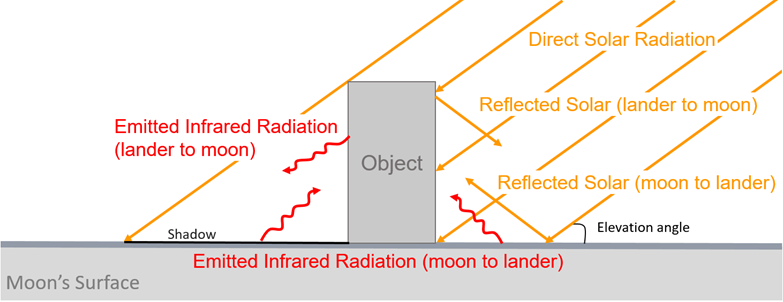
- Given the properties of Lunar regolith:A vehicle may receive almost as much energy from the Lunar surface (Albedo and Planetshine) as Direct Solar.
- Direct solar radiation : 1310 ~ 1426 W/m2
- Reflected solar radiation (albedo) : 91 ~ 285 W/m2
- Lunar IR radiation : ~1255 W/m2 (emissivity 0.95 ~ 0.98)
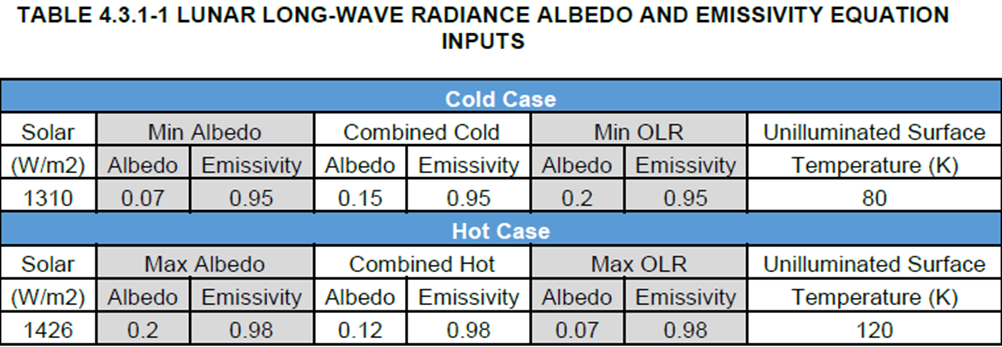
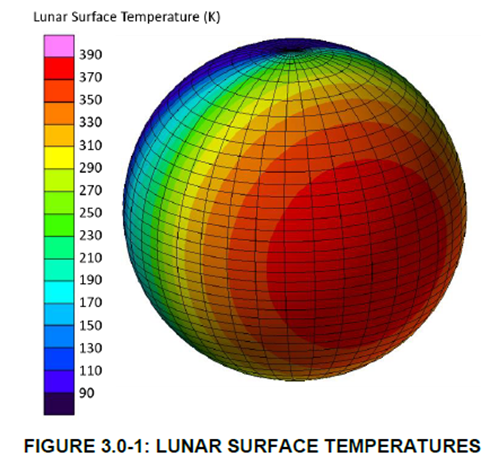
참고문헌 : HLS-UG-001, Lunar Thermal Analysis Guidebook, Cross-Program Design Specification for Natural Environments (DSNE)
Since the lunar surface has a very low thermal conductivity, surface temperatures are sensitive to shading from vehicles or surface features
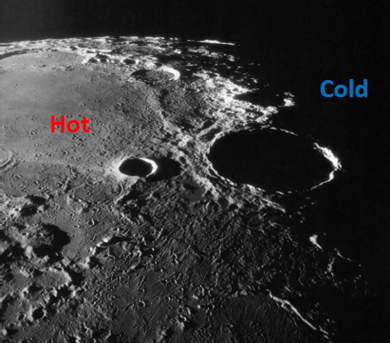
Moon as Seen from Apollo 11 (NASA Photo)
Lunar Surface Modeling Guidelines/Approaches
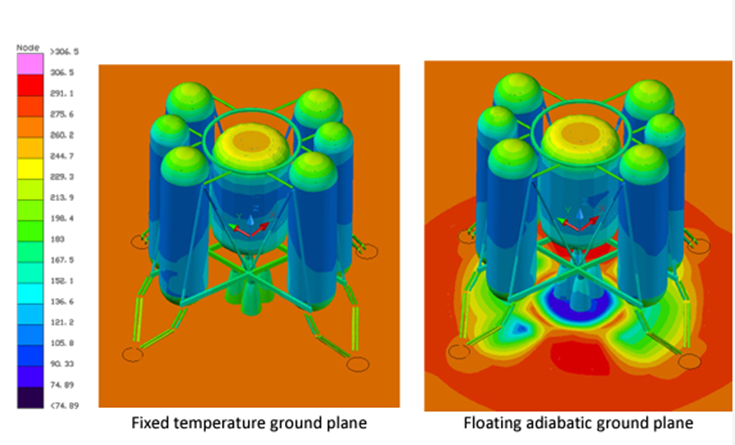
- Modeling the ground-plane solar environment
Lunar Regolith Model
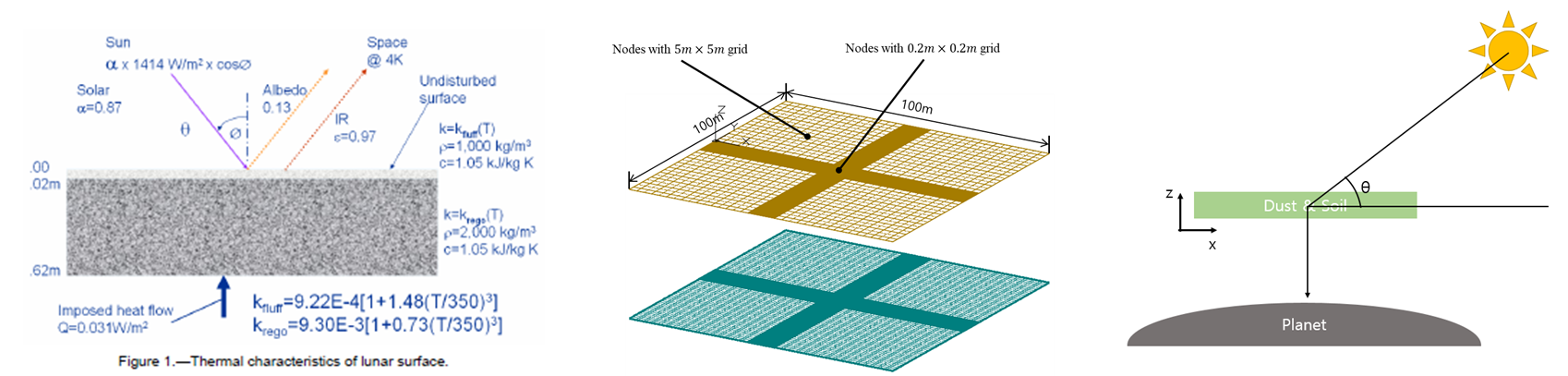
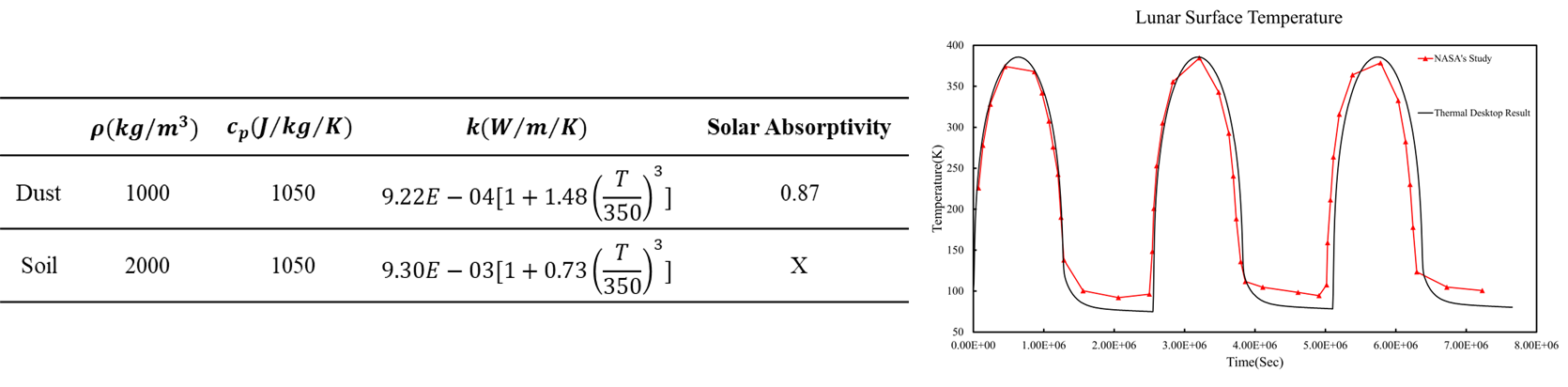
참고문헌 : Transient Thermal Model and Analysis of the Lunar Surface and Regolith for Cryogenic Fluid Storage, NASA technical report
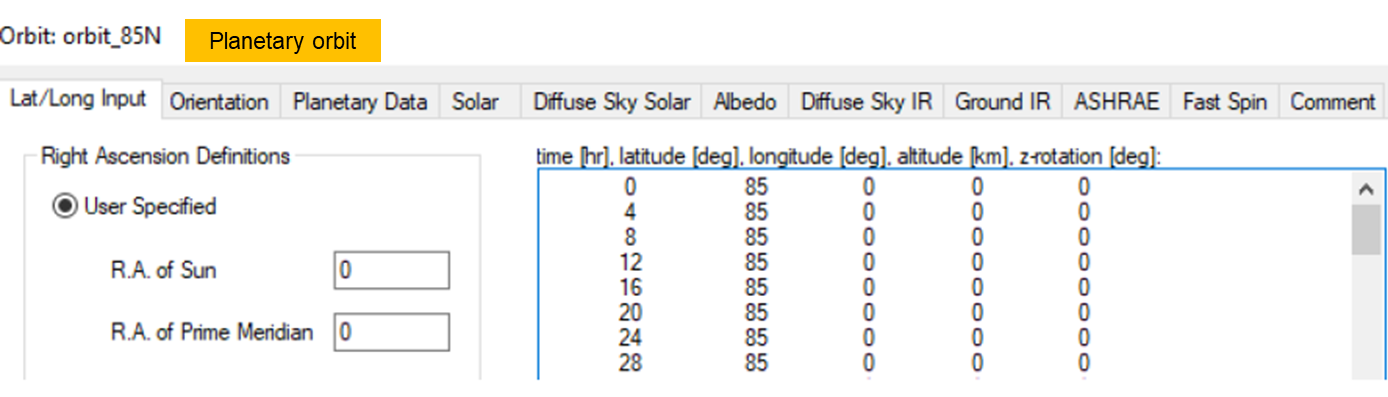
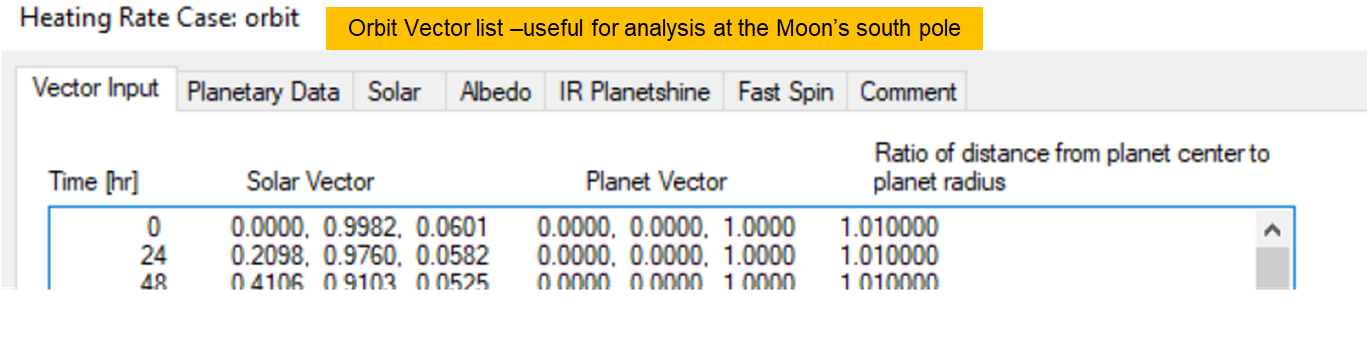
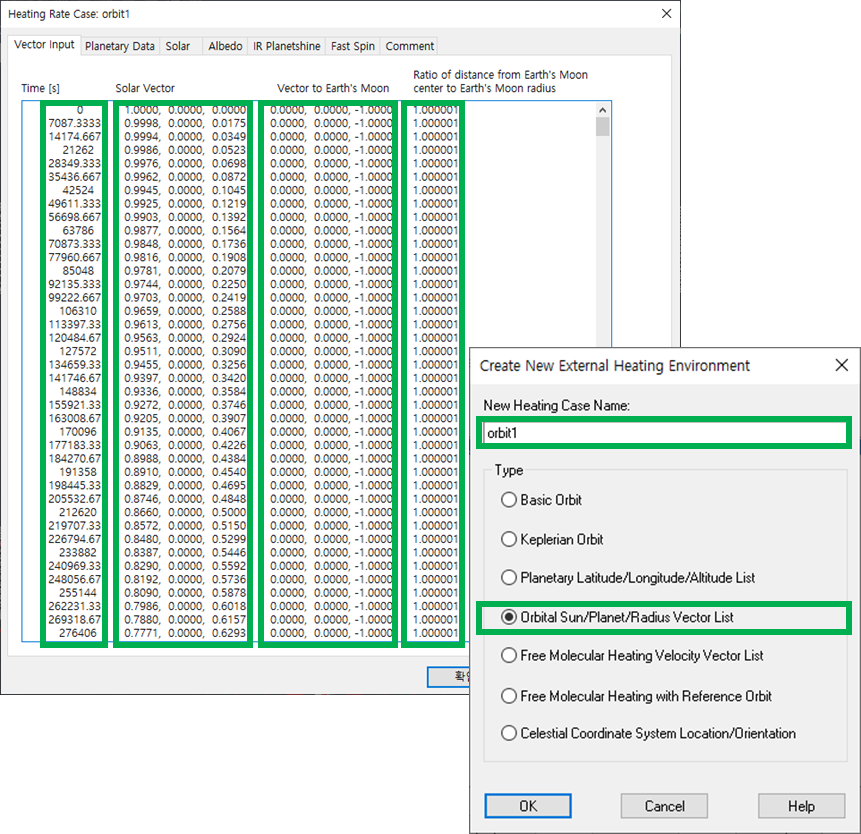
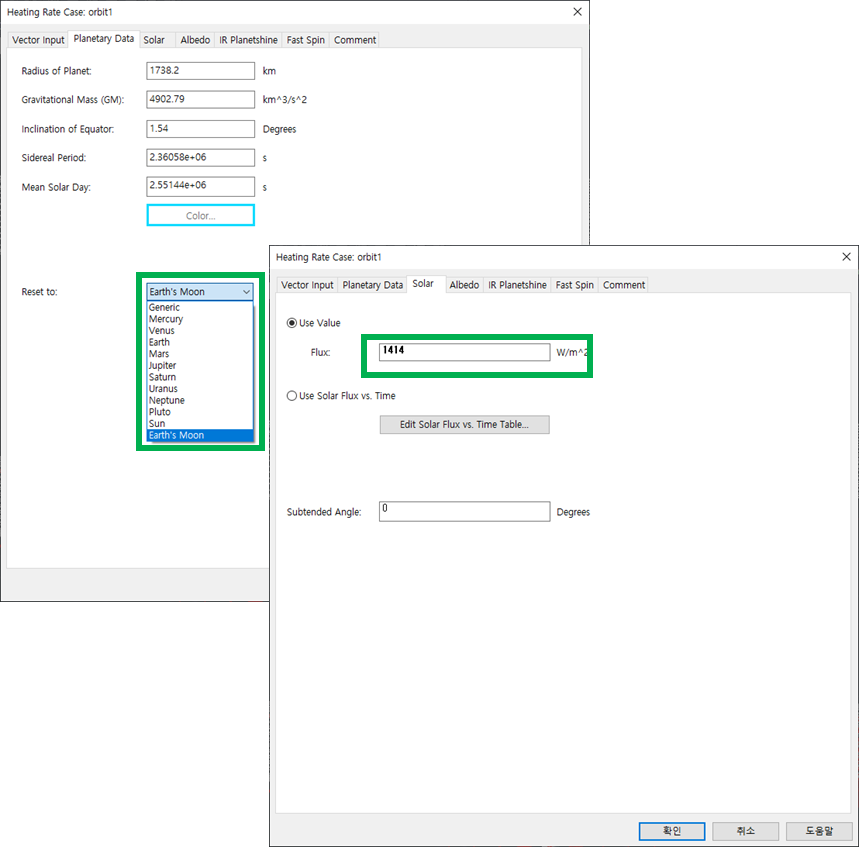
Orbit definition in Thermal Desktop


Thermal Desktop Overview
Thermal Desktop 특징
Lunar Surface Thermal Environment
참고문헌 : HLS-UG-001, Lunar Thermal Analysis Guidebook, Cross-Program Design Specification for Natural Environments (DSNE)
Since the lunar surface has a very low thermal conductivity, surface temperatures are sensitive to shading from vehicles or surface features
Moon as Seen from Apollo 11 (NASA Photo)
Lunar Surface Modeling Guidelines/Approaches
Lunar Regolith Model
참고문헌 : Transient Thermal Model and Analysis of the Lunar Surface and Regolith for Cryogenic Fluid Storage, NASA technical report
Orbit definition in Thermal Desktop