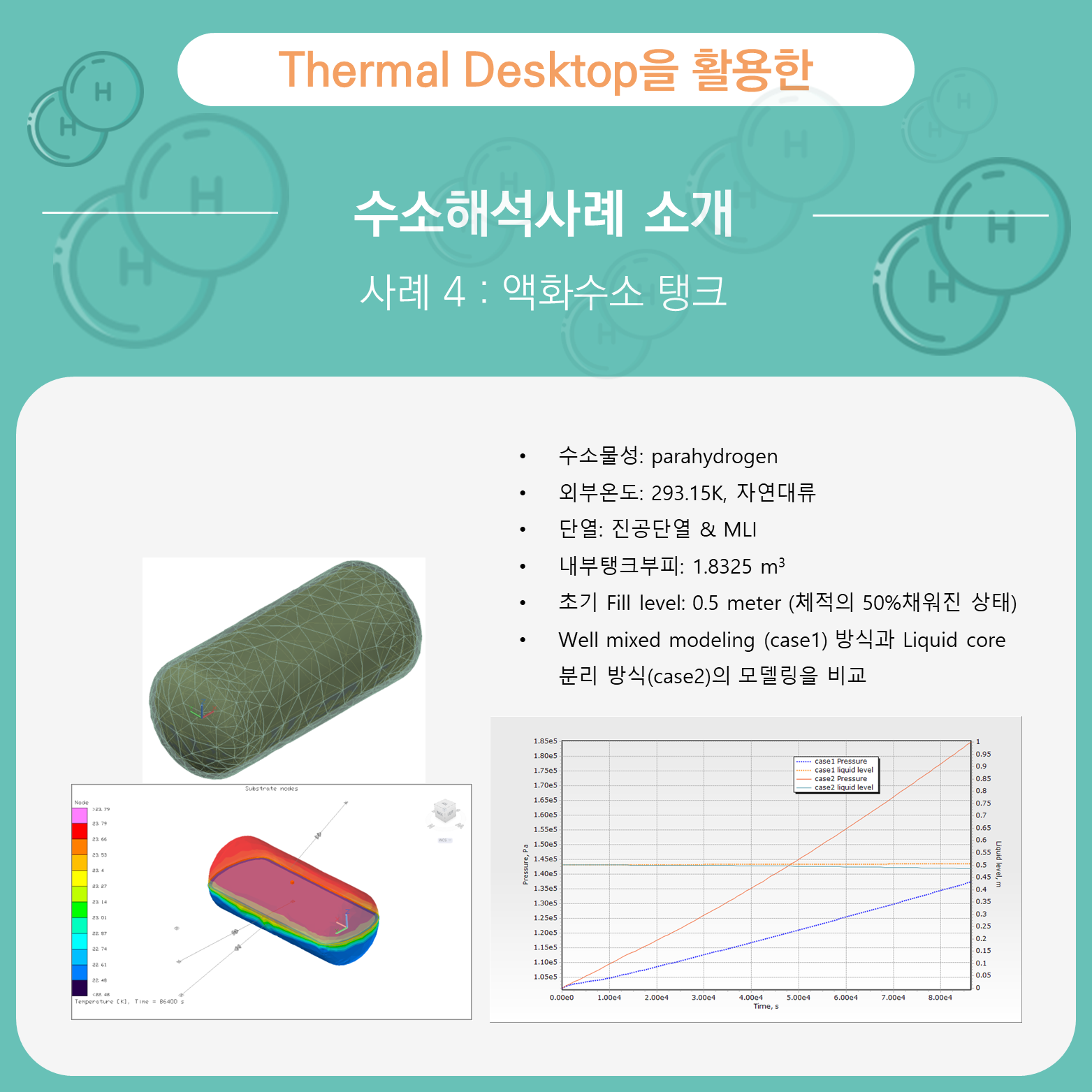
사례4: 액화수소 탱크

- 수소물성: parahydrogen
- 외부온도: 293.15K, 자연대류
- 단열: 진공단열 & MLI
- 내부탱크부피: 1.8325 m3
- 초기 Fill level: 0.5 meter (체적의 50%채워진 상태)
- Well mixed modeling (case1) 방식과 Liquid core 분리 방식(case2)의 모델링을 비교
Thermal/Fluid Network 해석의 Basic Concept

Model Considerations
- Multiple or singular lumps in the liquid and vapor regions of the Tank
- Real gases (also mixtures) and compressible liquids
- Venting, pressurizing, and draining
- Condensation and evaporation/boiling
- Wall heat transfer
- Elliptical, cylindrical, and spherical tank geometries
First Order Stratification Modeling
- Ullage : nearly completely stagnant
- Liquid : slow recirculation with isolated core
- Isolated most (85~95%) of liquid in “blocked” core
- Recirculate between side/top and core liquid volumes based on boundary layer heat transfer
- Can include fill, drain, pressurize and vent
- Only useful for short term holds

Refined Stratification Modeling
- More detail in the liquid core
- For improved prediction of extracted liquid temperatures
- Allows longer term holds
- Uses a flat-front (FF) Pipe to model the core liquid
- Requires more detailed recirculation calculation
- More difficult to apply in spherical or horizontal tanks
- Core isolation fraction is still a key uncertainty

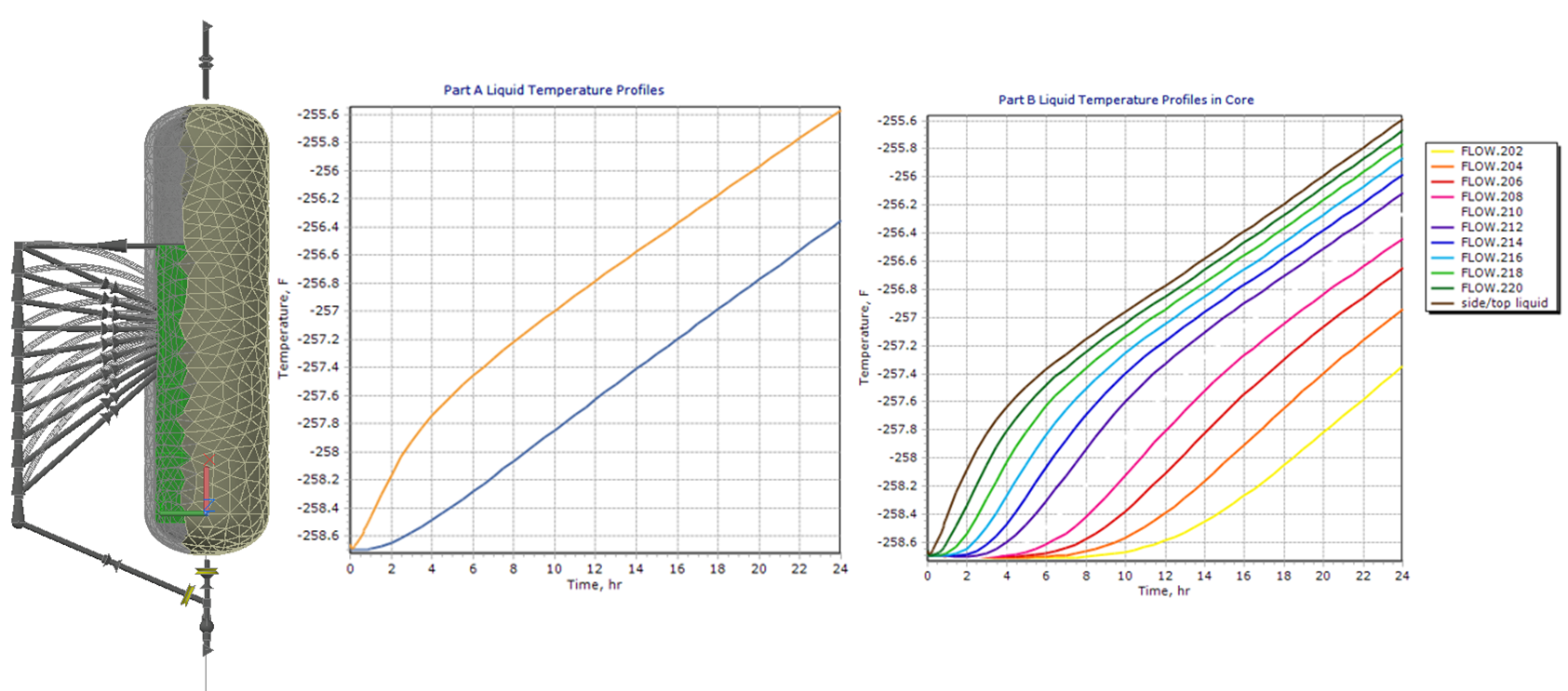


사례4: 액화수소 탱크
Thermal/Fluid Network 해석의 Basic Concept
Model Considerations
First Order Stratification Modeling
- Isolated most (85~95%) of liquid in “blocked” core
- Recirculate between side/top and core liquid volumes based on boundary layer heat transfer
Refined Stratification Modeling
- For improved prediction of extracted liquid temperatures
- Allows longer term holds
- Requires more detailed recirculation calculation