FSI Analysis of a Hydraulic Engine Mount The advanced fluid-structure interaction (FSI) analysis capabilities of ADINA are widely used in the automotive industry, and previous ADINA News features showcased many automotive applications. Among these, we presented two applications of ADINA in the analysis of automotive hydraulic engine mounts (HEMs) on August 14, 2002 and May 15, 2002. This time, we present a model of an HEM with a different design, solved by an ADINA user*. There are many details in this complex analysis, but the analysis is probably of interest to engineers working in the field of designing HEMs. The design features a spiral-curved inertia track (channel) connecting two fluid chambers, and a free decoupler. The free decoupler can be seen above in the mesh plot of the solid model. The inertia track is shown in the mesh plot of the fluid model, and can also be visualized with the help of the particle trace plot in the accompanying animation. The inertia track acts as a tuned damper that is designed to provide damping at low frequencies and large amplitudes. The free decoupler is usually a plastic plate. It dominates the interaction between the two fluid chambers for high frequencies and small amplitudes. The model was analyzed for its response to a sinusoidal excitation applied as shown in the mesh plot of the solid model. The results are illustrated in the above animation with particle traces inside the fluid chambers and the inertia track. The left figure below shows the time history of the transmitted force to the fixed part of the rubber spring, while the figure to the right shows the time history of the upper chamber pressure. The ADINA-FSI results agree very well with the experimental results. 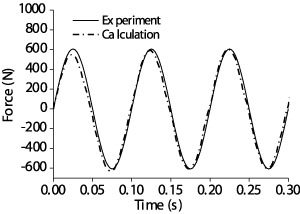
| 


FSI Analysis of a Hydraulic Engine Mount
The advanced fluid-structure interaction (FSI) analysis capabilities of ADINA are widely used in the automotive industry, and previous ADINA News features showcased many automotive applications. Among these, we presented two applications of ADINA in the analysis of automotive hydraulic engine mounts (HEMs) on August 14, 2002 and May 15, 2002.
This time, we present a model of an HEM with a different design, solved by an ADINA user*. There are many details in this complex analysis, but the analysis is probably of interest to engineers working in the field of designing HEMs.
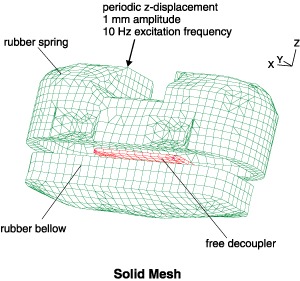
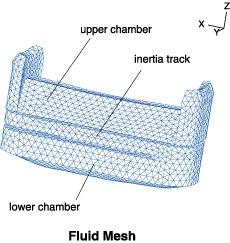
The design features a spiral-curved inertia track (channel) connecting two fluid chambers, and a free decoupler. The free decoupler can be seen above in the mesh plot of the solid model. The inertia track is shown in the mesh plot of the fluid model, and can also be visualized with the help of the particle trace plot in the accompanying animation. The inertia track acts as a tuned damper that is designed to provide damping at low frequencies and large amplitudes. The free decoupler is usually a plastic plate. It dominates the interaction between the two fluid chambers for high frequencies and small amplitudes.
The model was analyzed for its response to a sinusoidal excitation applied as shown in the mesh plot of the solid model. The results are illustrated in the above animation with particle traces inside the fluid chambers and the inertia track. The left figure below shows the time history of the transmitted force to the fixed part of the rubber spring, while the figure to the right shows the time history of the upper chamber pressure. The ADINA-FSI results agree very well with the experimental results.