FSI Analysis of Abdominal Aortic Aneurysms
ADINA for FSI is widely used in many biomedical engineering studies. In the ADINA FSI capabilities, the Navier-Stokes fluid flow is fully coupled to the small or large deformation capabilities for solids and structures. One area of application is the study of fluid-structure interactions between blood and arterial tissue.
The article "Fluid-structure interaction in abdominal aortic aneurysms: effects of asymmetry and wall thickness" published in BioMedical Engineering OnLine 2005, 4:64 describes the FSI analysis of abdominal aortic aneurysms to predict the transient interaction between the blood and the flexible artery walls. Using ADINA, the arterial wall stresses are predicted for different geometric configurations (aneurysm asymmetry) and wall thicknesses to evaluate their effect on the risk of aneurysm rupture.
Figure 1 below depicts (a) the fluid (brown) and solid (blue) domains including the internal fluid-structure interface, and (b) the solid domain with variable wall thickness. Figure 2 shows the deformations of the aneurysm (a) for uniform wall thickness and (b) for variable wall thickness. The red mesh represents the original non-deformed artery.
In this study, ADINA 8.0 was used, which was released more than 3 years ago. A much more powerful ADINA version 8.3 was released recently.
The reader may refer to the complete text of the article for more information:
http://www.biomedical-engineering-online.com/content/4/1/64
A brief summary of the FSI capabilities available in ADINA is given here:
http://www.adina.com/fsi.shtml
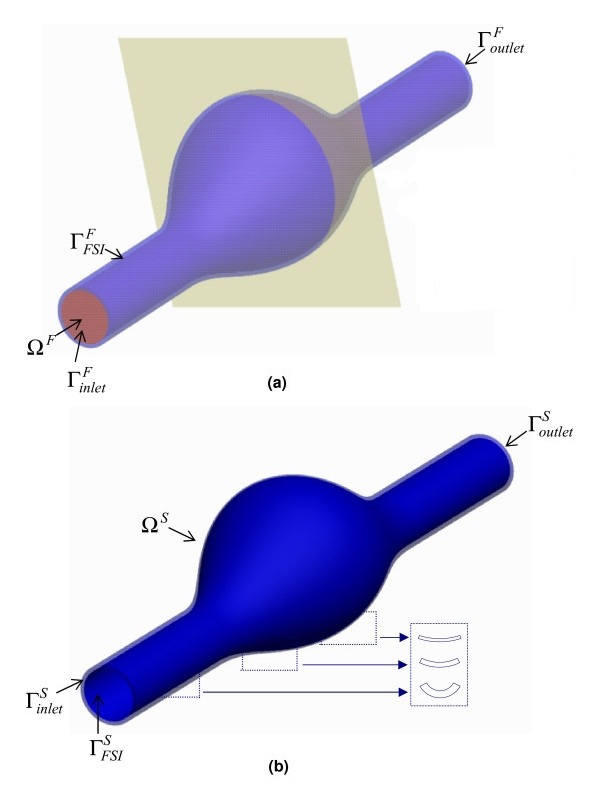 Figure 1: CAD geometry of the aneurysm model
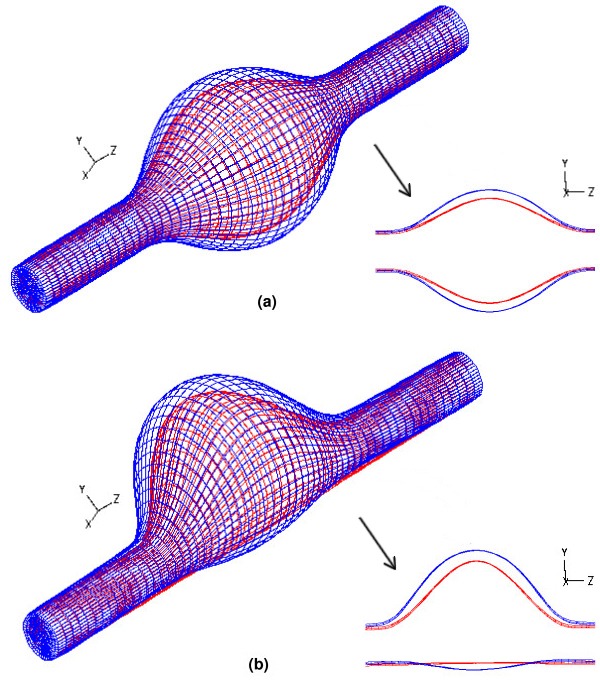 Figure 2: Deformations of the aneurysm
Courtesy of Dr. E. Finol, Carnegie Mellon University


FSI Analysis of Abdominal Aortic Aneurysms
ADINA for FSI is widely used in many biomedical engineering studies. In the ADINA FSI capabilities, the Navier-Stokes fluid flow is fully coupled to the small or large deformation capabilities for solids and structures. One area of application is the study of fluid-structure interactions between blood and arterial tissue.
The article "Fluid-structure interaction in abdominal aortic aneurysms: effects of asymmetry and wall thickness" published in BioMedical Engineering OnLine 2005, 4:64 describes the FSI analysis of abdominal aortic aneurysms to predict the transient interaction between the blood and the flexible artery walls. Using ADINA, the arterial wall stresses are predicted for different geometric configurations (aneurysm asymmetry) and wall thicknesses to evaluate their effect on the risk of aneurysm rupture.
Figure 1 below depicts (a) the fluid (brown) and solid (blue) domains including the internal fluid-structure interface, and (b) the solid domain with variable wall thickness. Figure 2 shows the deformations of the aneurysm (a) for uniform wall thickness and (b) for variable wall thickness. The red mesh represents the original non-deformed artery.
In this study, ADINA 8.0 was used, which was released more than 3 years ago. A much more powerful ADINA version 8.3 was released recently.
The reader may refer to the complete text of the article for more information:
http://www.biomedical-engineering-online.com/content/4/1/64
A brief summary of the FSI capabilities available in ADINA is given here:
http://www.adina.com/fsi.shtml
Courtesy of Dr. E. Finol, Carnegie Mellon University