| Simulation of Phase Changes Using ADINA |
|
Phase change phenomena are common in many industries. The distinguishing feature of phase change phenomena is the interface between different phases, generated through thermodynamic processes. Generally, the interfaces between different phases represent very thin zones over which material properties (density, viscosity, thermal conductivity) and solution variables (velocity, temperature, pressure) change significantly. Phase change phenomena are generally highly nonlinear and the interfaces can move significantly. To study phase change problems, the numerical methods utilized should have the capability to accurately capture the interface locations and the sharp variations of variables across them.
In this Brief, we use ADINA to solve, in 2D and 3D, problems involving melting of gallium. Figure 1 shows the schematic of the 2D gallium melting problem solved with ADINA. |
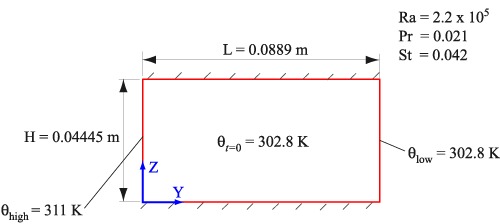 |
Figure 1 Schematic of the 2D gallium melting problem; all no-slip walls,
adiabatic conditions on walls unless the temperature is prescribed
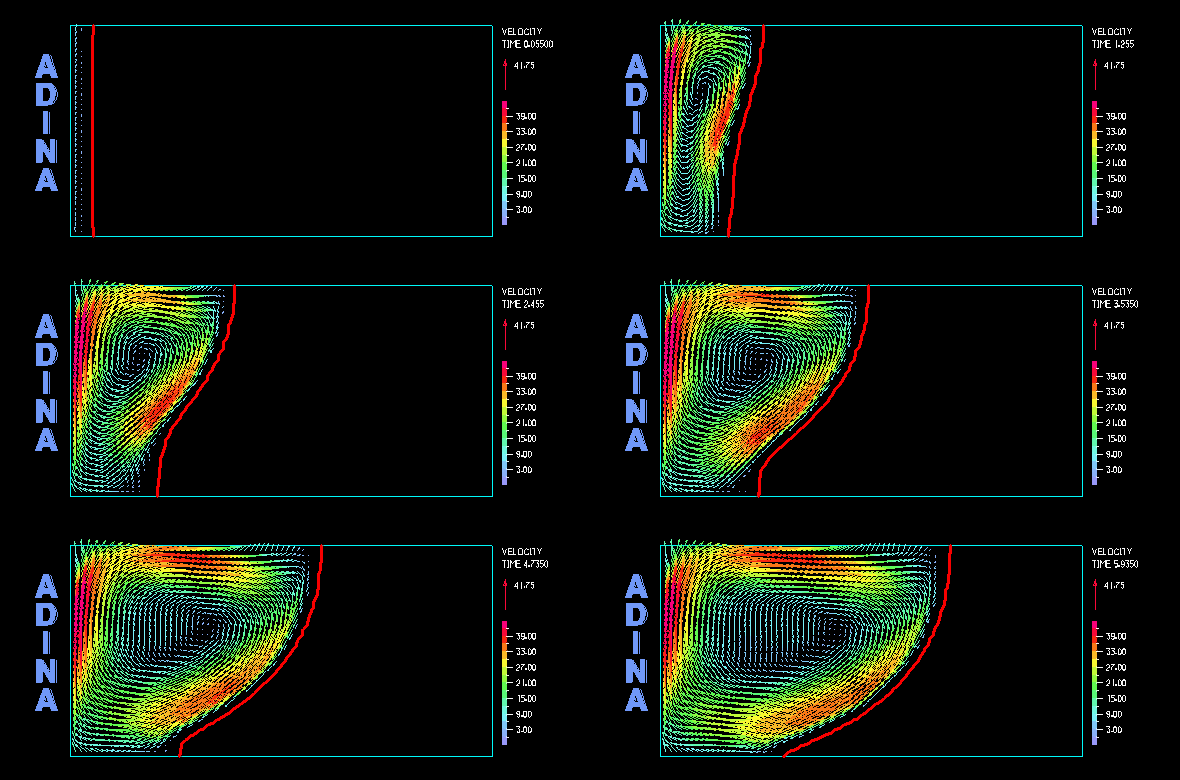
The movie above shows the time variations of the velocity profile and the interface location. As time increases, the top part of the interface moves to the right faster than its bottom part due to faster melting. This faster melting in the top part is driven by a large clockwise recirculating eddy, which is generated by the natural convection of the molten gallium. The size of the eddy increases with time. This observation is consistent with experimental and other numerical observations.
Figure 2 shows interface shape and location comparisons between the experimental results of Gau & Viskanta [1], the ADINA results, and the numerical results of Webb & Viskanta [2]. The ADINA results agree reasonably well with the experimental results. |
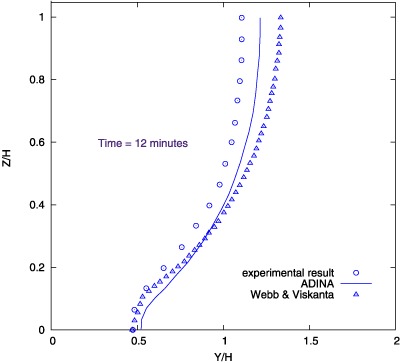 |
Figure 2 2D gallium melting problem — interface location comparisons
Figure 3 gives the schematic of the 3D gallium melting problem solved with ADINA.
|
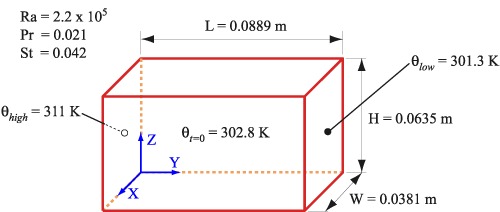 |
Figure 3 Schematic of the 3D gallium melting problem; all no-slip walls,
adiabatic conditions on walls unless the temperature is prescribed
Figure 4 shows, for the 3D problem, interface shape and location comparisons between the Gau & Viskanta experimental results [1] and the ADINA results. We see that the numerical results agree quite well with the experimental results. |
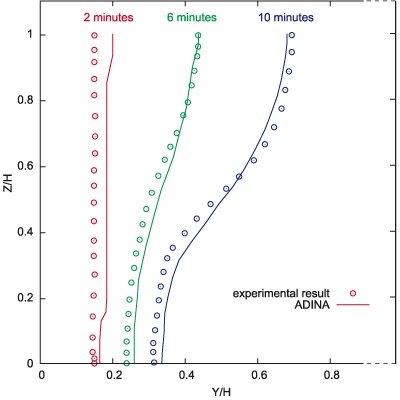 |
Figure 4 3D gallium melting problem — interface location comparisons
The numerical solution of this melting problem demonstrates some of the features of ADINA for the analysis of phenomena involving fluid flow, heat transfer and phase changes, common in industrial casting and molding processes. For more examples of the powerful multiphysics capabilities of ADINA, see ADINA Multiphysics.
References
- Gau C. and Viskanta, R. "Melting and solidification of a pure metal on a vertical wall", Journal of Heat Transfer, 108 :174-181, 1986
- Webb, B.W. and Viskanta, R. "Analysis of heat transfer during melting of a pure metal from an isothermal vertical wall", Numerical Heat Transfer, 9:539-558, 1986
Keywords:
CFD, phase change, heat transfer, melting, casting, molding, gallium |


Phase change phenomena are common in many industries. The distinguishing feature of phase change phenomena is the interface between different phases, generated through thermodynamic processes. Generally, the interfaces between different phases represent very thin zones over which material properties (density, viscosity, thermal conductivity) and solution variables (velocity, temperature, pressure) change significantly. Phase change phenomena are generally highly nonlinear and the interfaces can move significantly. To study phase change problems, the numerical methods utilized should have the capability to accurately capture the interface locations and the sharp variations of variables across them.
In this Brief, we use ADINA to solve, in 2D and 3D, problems involving melting of gallium. Figure 1 shows the schematic of the 2D gallium melting problem solved with ADINA.
Figure 1 Schematic of the 2D gallium melting problem; all no-slip walls,
The movie above shows the time variations of the velocity profile and the interface location. As time increases, the top part of the interface moves to the right faster than its bottom part due to faster melting. This faster melting in the top part is driven by a large clockwise recirculating eddy, which is generated by the natural convection of the molten gallium. The size of the eddy increases with time. This observation is consistent with experimental and other numerical observations.adiabatic conditions on walls unless the temperature is prescribed
Figure 2 shows interface shape and location comparisons between the experimental results of Gau & Viskanta [1], the ADINA results, and the numerical results of Webb & Viskanta [2]. The ADINA results agree reasonably well with the experimental results.
Figure 2 2D gallium melting problem — interface location comparisons
Figure 3 gives the schematic of the 3D gallium melting problem solved with ADINA.Figure 3 Schematic of the 3D gallium melting problem; all no-slip walls,
Figure 4 shows, for the 3D problem, interface shape and location comparisons between the Gau & Viskanta experimental results [1] and the ADINA results. We see that the numerical results agree quite well with the experimental results.adiabatic conditions on walls unless the temperature is prescribed
Figure 4 3D gallium melting problem — interface location comparisons
The numerical solution of this melting problem demonstrates some of the features of ADINA for the analysis of phenomena involving fluid flow, heat transfer and phase changes, common in industrial casting and molding processes. For more examples of the powerful multiphysics capabilities of ADINA, see ADINA Multiphysics.References
- Gau C. and Viskanta, R. "Melting and solidification of a pure metal on a vertical wall", Journal of Heat Transfer, 108 :174-181, 1986
- Webb, B.W. and Viskanta, R. "Analysis of heat transfer during melting of a pure metal from an isothermal vertical wall", Numerical Heat Transfer, 9:539-558, 1986
Keywords:CFD, phase change, heat transfer, melting, casting, molding, gallium